SonIQ
Identify music in any video entirely on your Mac. Drop a file, extract the tracks without compromising privacy, and export them to Spotify or YouTube.
 React
 Tauri
 Vite
 Objective-C
 FFmpeg
 Framer Motion

Introduction
I'm a computer science student, and I edit videos in my free time. My personal drive is filled with reference clips, videos and other files.
Problem
Often, I wonder what songs are being used in videos and want to find them later. But holding my phone to the speakers and trying to Shazam a song before the voiceover comes on is quite time consuming. Plus, I don't like uploading my project files to some random website just to identify a song.
Solution
So I built SonIQ (pronounced sonic). It's a local macOS app that runs entirely on your device. You drop a video in, it extracts the audio, generates a fingerprint, and matches it. The files never leave your Mac, and you can export the found tracks straight to your Spotify or YouTube playlists.
How I Came Up With the Name
Here's the thought process behind the branding and logo:How I built it

Building SonIQ
SonIQ was built for the OpenAI Build Challenge using Codex and GPT-5.6 models.
I ain't gonna lie, this was my first ever experience with Rust. It was a lot easier since I have a technical background in development and knew exactly what I wanted to build. So I had GPT-5.6 Terra write the audio extraction pipeline.
Figuring out the exact FFmpeg flags for downmixing audio usually takes a lot of trial and error with the docs, but the output I got was beyond my expectations.
I used GPT-5.6 Terra for the hard parts of Tauri. Audio fingerprinting is heavy, and my first try completely froze the UI. GPT-5.6 Terra walked me through fixing it by moving the extraction to a background thread in Rust so the app stayed responsive.
It also helped me out when I was building the macOS .dmg. Packaging external binaries in Tauri is confusing, but GPT-5.6 Terra gave me the exact config I needed so the app wouldn't instantly crash when someone else tried to run it.
Architecture
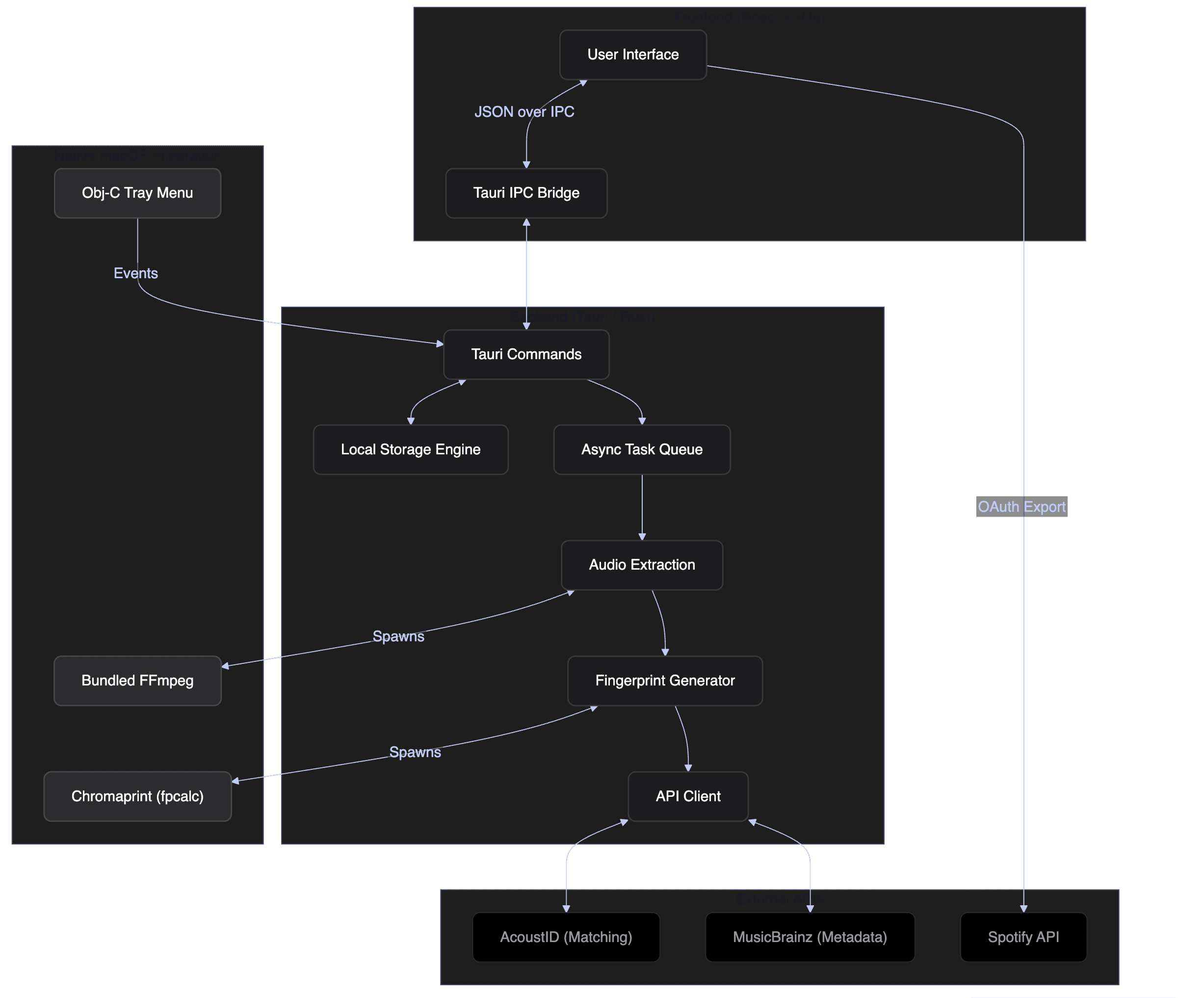
Takeaways
Working with GPT-5.6 taught me how to actually direct an AI model instead of just typing prompts. The code quality depends entirely on how well you can architect the system upfront.
Building a desktop app forced me out of my comfort zone. Managing background threads in Rust and hooking up a native macOS tray menu was tough, but completely worth it to keep the UI from freezing.
I learned how to handle a project from start to finish. Beyond just writing code, I had to figure out how to package external binaries into a macOS installer, set up GitHub Actions and write documentation that actually makes sense.